
You are not bad at tracking. You just cannot see inside the kitchen
Sep 17, 2026
Tracking your food at home is a doddle once you have done it a few times. You know the brand of yoghurt, the bag of rice weighs what it says on the bag, and you know roughly how much oil went in the pan because you put it there. The numbers might not be perfect, but they are close enough to be useful.
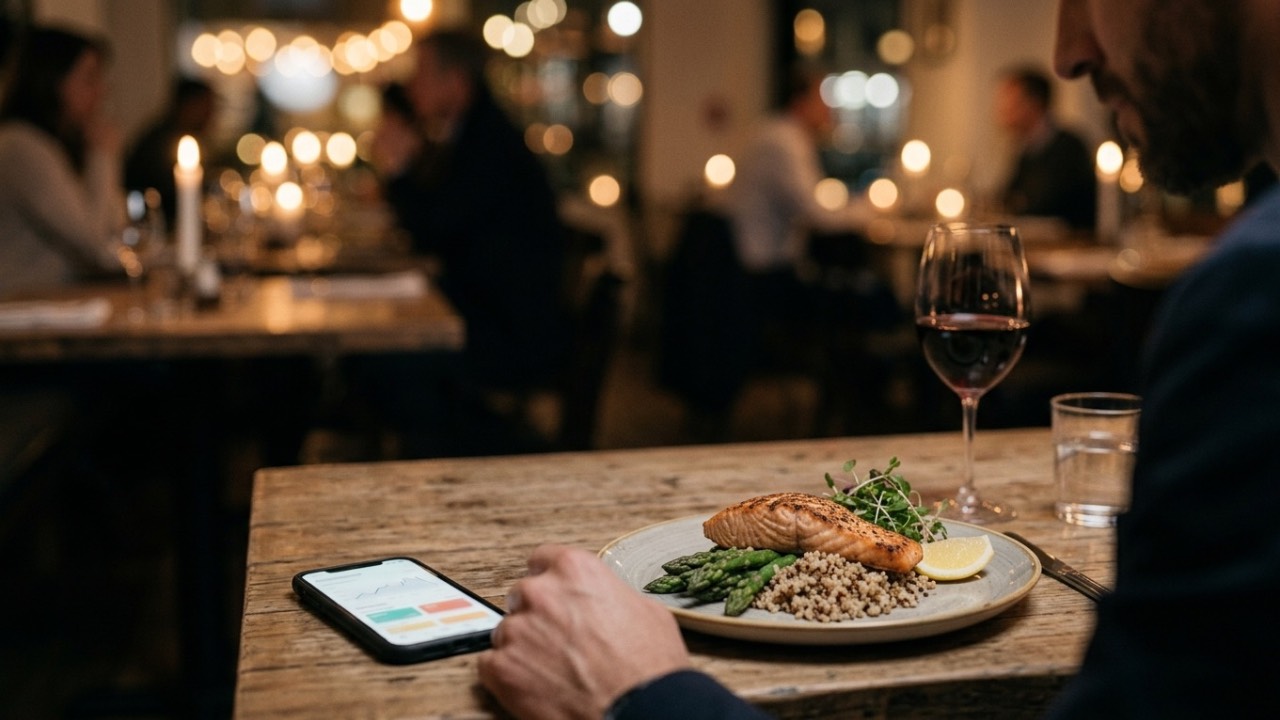
Then someone books a table on a Thursday night and the whole thing falls over. You are sat in front of a plate that arrived with a sauce nobody mentioned, on a bed of something that was almost certainly finished with a knob of butter. You have no clue what went into it. So you either guess wildly, pick the closest looking entry in the app and move on feeling a bit uneasy, or you skip logging it altogether and tell yourself you will be good tomorrow.
That is an information problem, not a discipline problem, and the two need completely different fixes. Nobody can accurately log a meal they did not cook. You are being asked to reverse engineer a recipe you have never seen, from a plate, in a dark room, after a glass of wine.
The short answer: you cannot track a restaurant meal accurately, and you do not need to. Estimate high rather than low, build the plate around protein and veg where you can, and log something rather than nothing. An estimate that is 300 calories out still keeps your weekly average roughly honest. A blank tells you nothing at all, and a blank is usually what comes before writing off the rest of the week.
Why restaurant food refuses to be pinned down
It is worth understanding why this is hard, because once you do, you stop treating it as a personal failing.
- The cooking fats are invisible. Chefs cook with butter and oil because it tastes good, and they are not shy with it. A pan of veg that reads as a healthy side can carry a serious amount of fat that never appears on the menu.
- Portions are not standard. The same dish at two different places can be wildly different sizes. A "chicken breast" might be 150g or it might be 300g, and nobody is weighing it out back.
- Sauces and dressings do the damage. They are mostly oil, cream or sugar, and they are the bit you notice least. A generous dressing on a salad can quietly outweigh the thing it is dressed on.
- The app entries are guesses too. Most database entries for restaurant meals were typed in by another user who was estimating exactly like you are. You are not looking up a fact, you are borrowing someone else's guess.
Put all that together and the honest position is this: your logged number for a meal out is a range, not a figure. Once you make peace with that, the job gets a lot easier.
What you are actually aiming for
The goal is damage control. You are trying to stop one evening from turning into a bad fortnight.
Run the numbers on it. Say your target is 2,200 a day, so 15,400 across the week. You go out Thursday and the meal lands at 1,600 instead of the 800 you would have eaten at home. That is 800 over, which is about five per cent of your week. Spread across seven days, it is close to nothing. You would struggle to see it on the scales.
Now look at what usually happens instead. The meal feels like a failure, so Thursday does not get logged. Friday feels pointless because Thursday was already ruined. Saturday goes the same way, and you restart on Monday. That is three or four days of guessing instead of one meal of guessing, and it can easily run to several thousand calories you never saw. The meal was never the problem. The write off that followed it was.
So the standard you are holding yourself to is not accuracy. It is keeping the log unbroken and the number in the right postcode.
Five things that work when you are out
1. Accept that this bit is genuinely hard
This sounds soft, but it matters. People who expect to track a restaurant meal precisely end up frustrated, and frustrated people stop tracking. If you go in knowing the number will be rough, a rough number feels like a success instead of a failure. Same outcome, completely different chance of you still doing this in three months.
2. Estimate higher than feels fair
When you are unsure, round up, then round up again. Almost everyone under-eggs a meal out, because you are picturing the version you would make at home rather than the version the chef made with a ladle of butter.
A decent rule of thumb: whatever figure you first land on, add a third. If you think the carbonara was 900, log 1,200. Over-estimating costs you a slightly smaller portion tomorrow. Under-estimating costs you six weeks of wondering why nothing is shifting while you cut your weekday calories for no reason.
3. Borrow a number from a chain
Independent restaurants publish nothing. Big chains publish everything, because they have to. So use them as your reference library.
If you have had a burger and chips at a local place, look up a comparable burger and chips at a large chain and take that number, or a bit above it. It will not be exact, but it is built on a real recipe rather than thin air, and it will be far closer than whatever you would have invented. Do the same for a curry, a pizza, a stir fry, a full English. Build yourself a handful of go-to reference meals and you can log most nights out in about twenty seconds.
4. Have a look at the menu before you go
This is the one that does the heavy lifting, and it takes two minutes on your phone. Most places put the menu online. Pick your meal before you are sat down, hungry, with everyone else ordering.
Deciding in advance means you are choosing with a clear head rather than negotiating with yourself at the point of maximum hunger. It also lets you shape the rest of the day around it. If you know dinner is going to be big, keep breakfast and lunch protein-heavy and lighter than usual, and you arrive with room to spare.
While you are there, lean towards a plate built on a clear protein and some veg. Grilled, roasted or baked rather than creamy, battered or breaded. You do not need to order the saddest thing on the menu. You just need the main event to be something you can recognise.
5. Log something, always
Whatever you do, put a number in. Tonight, not tomorrow, because tomorrow you will remember it as smaller than it was.
If you genuinely have no idea, log your best guess and add a third as above. If you cannot face itemising it, log it as one lump entry with a rough total. A wrong number in the log is still a data point. An empty day is a hole in the week, and holes are what make people change their calories based on a picture that was never real.
The bottom line
Eating out is not a problem to be solved. It is most of the good bits of being alive, and any approach to fat loss that needs you to stop doing it is not going to last.
What you need is a way to handle it that takes thirty seconds and does not wreck the rest of your week. Check the menu beforehand, pick something built around protein, estimate on the high side, borrow a number from a chain if you are stuck, and get it in the log before you go to bed.
Do that and a meal out becomes a normal Thursday with a slightly bigger number on it. Which, in a week that is otherwise going fine, is exactly what it should be.
Want help putting this into practice?
Endeavour builds personalised coaching around your life, not the other way round. If you want a plan that survives a busy week, take a look at how we work:
- Transform for Men — body transformation coaching for busy professional men
- Transform for Women — body transformation coaching for busy professional women
Get our best advice by email
Practical training, nutrition and mindset advice for busy people. No spam, unsubscribe any time.
- Patrick Moorshead
At Endeavour we help busy professionals like you find that sweet spot between performance and lifestyle
